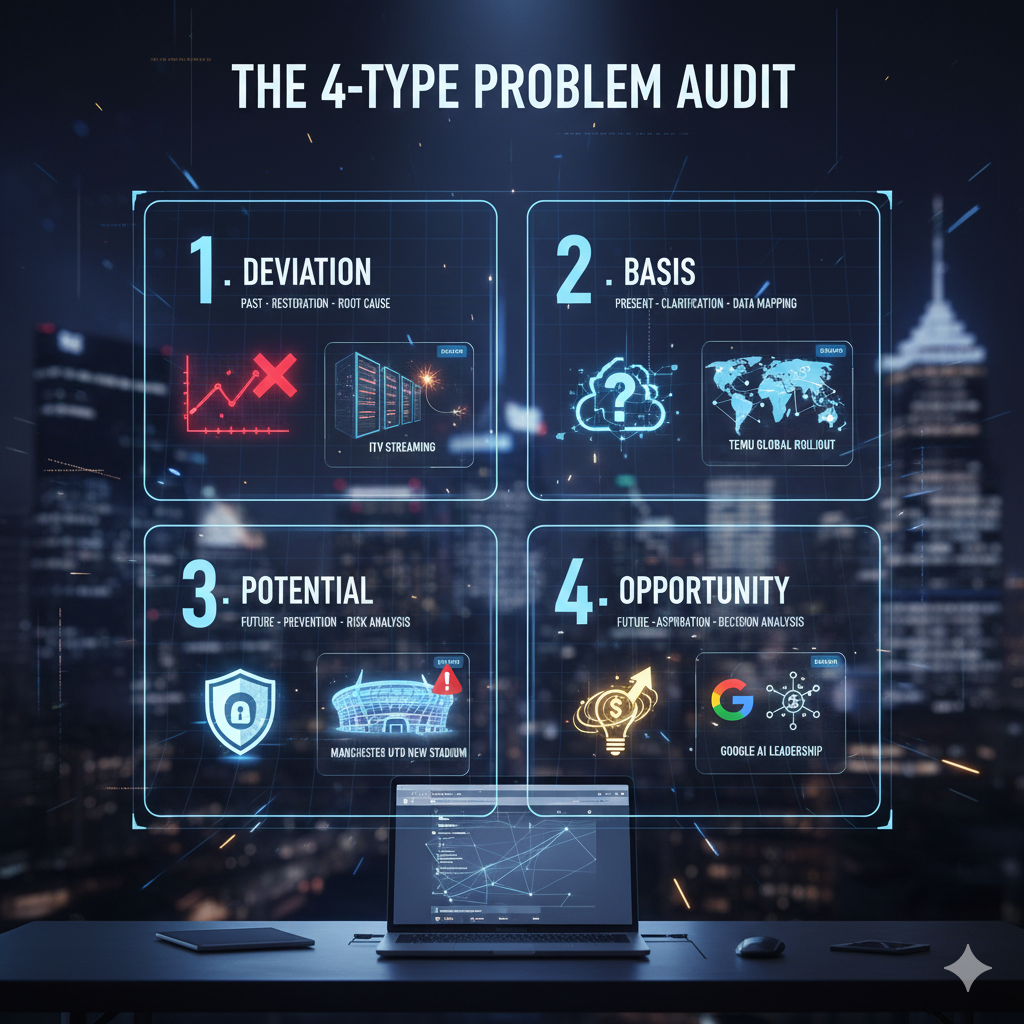
Beyond Fixing Fires: The Four Types Of Business Problem
By Independent Staff Writer BSc/MSc 24/12/2025
In the world of independent consultancy, the most common mistake leadership teams make is treating every problem like a "broken machine." In reality, business challenges are multi-dimensional. To build a resilient portfolio, an investor must distinguish between correcting the past and designing the future. Here are the four types of business problems, illustrated through the lens of today's market leaders.
| Problem Type | Focus | Psychological Context | Strategic Objective |
| 1. Deviation Problem | Past | Restoration: Why did a working system break? | Find the root cause and return to the "basis" or standard. |
| 2. Basis Problem | Present | Clarification: What is the actual standard? | Define the "Is/Is Not" parameters of the current situation. |
| 3. Potential Problem | Future | Prevention: What could go wrong if we change X? | Identify risks and create contingency plans. |
| 4. Opportunity Problem | Future | Aspiration: What could go "better" than the standard? | Maximise benefits and exploit potential gains (Decision Analysis). |
1. The Deviation Problem: The "Broken Standard"
A deviation problem occurs when a system that was working suddenly fails. The goal is simple: find the root cause and restore the status quo.
- The Case of ITV: In late 2025, ITV reported a sharp decline in traditional advertising revenue. The "deviation" isn't just the economy; it’s a shift in viewer behaviour toward streaming. Solving this requires a "restoration" of value by pivoting those advertisers to the ITVX platform.
2. The Basis Problem: The "Identity Crisis"
This isn't about a failure; it’s about a lack of clarity. A basis problem exists when the data is messy or the standard hasn't been defined.
- The Case of Temu: As Temu scales globally, they face a "basis" problem regarding customer lifetime value (LTV). Is the business model sustainable, or is it a high-burn acquisition play? Until the "basis" of their profitability is clearly defined, the market remains skeptical.
3. The Potential Problem: The "Risk Horizon"
This is a future-oriented problem. It asks: "What could stop our next big move?" It is the realm of contingency planning.
- The Case of Manchester United: The decision to build a new £2bn stadium is a massive strategic move. The "Potential Problems" are numerous—interest rate spikes, construction delays, or missing out on Champions League revenue. Professional management involves solving these problems before the first brick is laid.
4. The Opportunity Problem: The "Growth Frontier"
The fourth and most valuable type of problem is the Opportunity Problem. This isn't about what is wrong; it's about what could be better. It’s about choosing the best path among several lucrative alternatives.
- The Case of Google (Alphabet): Google doesn't have a "failure" problem; they have an "Opportunity" problem. They have the cash and the talent to lead in Search, Cloud, and AI. The problem they must solve is Decision Analysis: Which of these "Wants" should they prioritize to maintain their 100-year moat?
Summary for the Strategic Investor
To lead a company—or a portfolio—to success, you must identify which "problem" you are solving today. Are you fixing a Deviation at ITV, or are you chasing an Opportunity with Google? Mastering these four types of problems allows you to move from a reactive "firefighter" to a proactive "architect" of wealth.
The Architect’s Audit: The 4 Types of Business Problems
Strategic Insights for the Modern Investor. In professional consultancy, the most dangerous mistake a leader can make is misdiagnosing the nature of the problem they are solving. Treating an Opportunity like a Deviation leads to stagnation; treating a Potential Problem like a Basis Problem leads to catastrophe. To manage a high-stakes portfolio—from the digital dominance of Google to the cultural weight of Manchester United—you must master the four distinct quadrants of problem-solving.
1. The Deviation Problem (The "Broken Standard")
Focus: The Past | Psychology: Restoration A deviation problem occurs when a system that was functioning perfectly suddenly drops below the established standard.
- The Audit: You aren't looking for "new" ideas; you are looking for the Root Cause.
- Portfolio Example (ITV): If ITV’s streaming ad revenue suddenly dips despite high viewership, we are looking for a technical or structural "break" in the monetisation funnel. We solve to return to the status quo.
2. The Basis Problem (The "Identity Crisis")
Focus: The Present | Psychology: Clarification. A basis problem exists when there is no clear standard to deviate from. The "standard" itself is the problem because it is ill-defined, messy, or outdated.
- The Audit: You are looking for Data & Definition.
- Portfolio Example (Temu): As Temu expands into new Western markets, they face a "Basis Problem." What is a "good" customer acquisition cost in a high-inflation environment? Without this basis, every decision is a guess.
3. The Potential Problem (The "Risk Horizon")
Focus: The Future | Psychology: Prevention This is the realm of the "What If." It involves identifying future events that could derail a strategic move and creating "contingency buffers."
- The Audit: You are looking for Vulnerabilities.
- Portfolio Example (Manchester United): The proposed £2bn stadium is a massive future move. The potential problems (interest rate hikes, supply chain delays, or construction debt) must be solved mentally before they occur physically.
4. The Opportunity Problem (The "Value Frontier")
Focus: The Future | Psychology: Aspiration. The fourth and most sophisticated problem type. This isn't about fixing a gap; it’s about Decision Analysis. You have several paths to growth—which one is the most viable?
- The Audit: You are looking for Maximum Utility.
- Portfolio Example (Google): Google’s challenge with "Agentic AI" is an Opportunity Problem. They aren't "broken," but they face a choice: do they disrupt their own search ad model to lead in AI agents? Choosing the right path is the ultimate test of leadership.
The Consultant’s Verdict: Which are you solving?
As an investor, your job is to ensure that your management teams aren't just "firefighting" (Type 1). True wealth is built by moving through Deviation and Basis quickly so you can spend the majority of your cognitive energy on Opportunity Problems.
The 4-Type Problem Audit: A Leader’s Interactive Guide
Strategic Intelligence for the Modern Consultant. In business, "problem-solving" is often used as a catch-all term. However, applying a root-cause analysis to a growth opportunity is as ineffective as using a brainstorming session to fix a broken assembly line. As an independent professional, you must first identify the nature of the challenge before you select your tools. Below is a professional diagnostic quiz, followed by a deep-dive analysis of the four problem categories.
Part 1: The Diagnostic Quiz
Which "Pillar" is failing in your business today? Answer the following four questions to identify your primary problem type:
- Has a previously stable metric (revenue, speed, quality) suddenly dropped?
- If Yes: You likely have a Type 1: Deviation Problem.
- Is your team confused about what "success" actually looks like or lacks clear data?
- If Yes: You have a Type 2: Basis Problem.
- Are you about to launch a major initiative and feel a sense of unease about what could go wrong?
- If Yes: You have a Type 3: Potential Problem.
- Is your business stable, but you feel your competitors are innovating faster than you?
- If Yes: You have a Type 4: Opportunity Problem.
Part 2: The Framework (The 4 Types)
Type 1: The Deviation Problem (The "Firefighter")
Objective: Restoration. This occurs when there is a gap between "what is happening" and "what usually happens." It is reactive.
- The Consultant's Tool: Root Cause Analysis (5 Whys, Fishbone Diagram).
- Portfolio Insight: If ITV's streaming servers go down, you don't need a vision meeting; you need to find the bug and kill it.
Type 2: The Basis Problem (The "Architect")
Objective: Clarification. There is no "standard" to return to because the current state is chaotic or undefined.
- The Consultant's Tool: Situation Appraisal & Data Mapping.
- Portfolio Insight: Temu faces a basis problem when entering a new country. They must define the "basis" for delivery times and costs from scratch before they can optimize them.
Type 3: The Potential Problem (The "Guardian")
Objective: Prevention. This is future-oriented risk management. You are looking for "vulnerabilities" in a plan that hasn't started yet.
- The Consultant's Tool: Contingency Planning & Trigger Points.
- Portfolio Insight: For Manchester United, the "Potential Problem" of a new stadium isn't just the cost—it's the risk of losing "Brand Saliency" if the atmosphere of the new ground doesn't match the old one.
Type 4: The Opportunity Problem (The "Visionary")
Objective: Enhancement. This is the most sophisticated level. Nothing is "broken," but the current standard is no longer enough to win. This is where Design Thinking thrives.
- The Consultant's Tool: Decision Analysis & Prototyping.
- Portfolio Insight: Google isn't solving a "bug" with AI; they are solving an Opportunity Problem. They are choosing between multiple profitable futures to ensure they remain the global gateway to information.
Part 3: Why This Matters for Your Website Visitors
If you are an independent professional, your value isn't just in solving problems; it's in reframing them. When a client says, "We have a problem," your first job is to ask: "Is this a fire we need to put out (Type 1), or a future we need to build (Type 4)?" By categorising the chaos, you provide the one thing every leader craves: Certainty of Direction.
"Struggling with an Opportunity Problem? Book a 30-minute strategy session to map your next move."