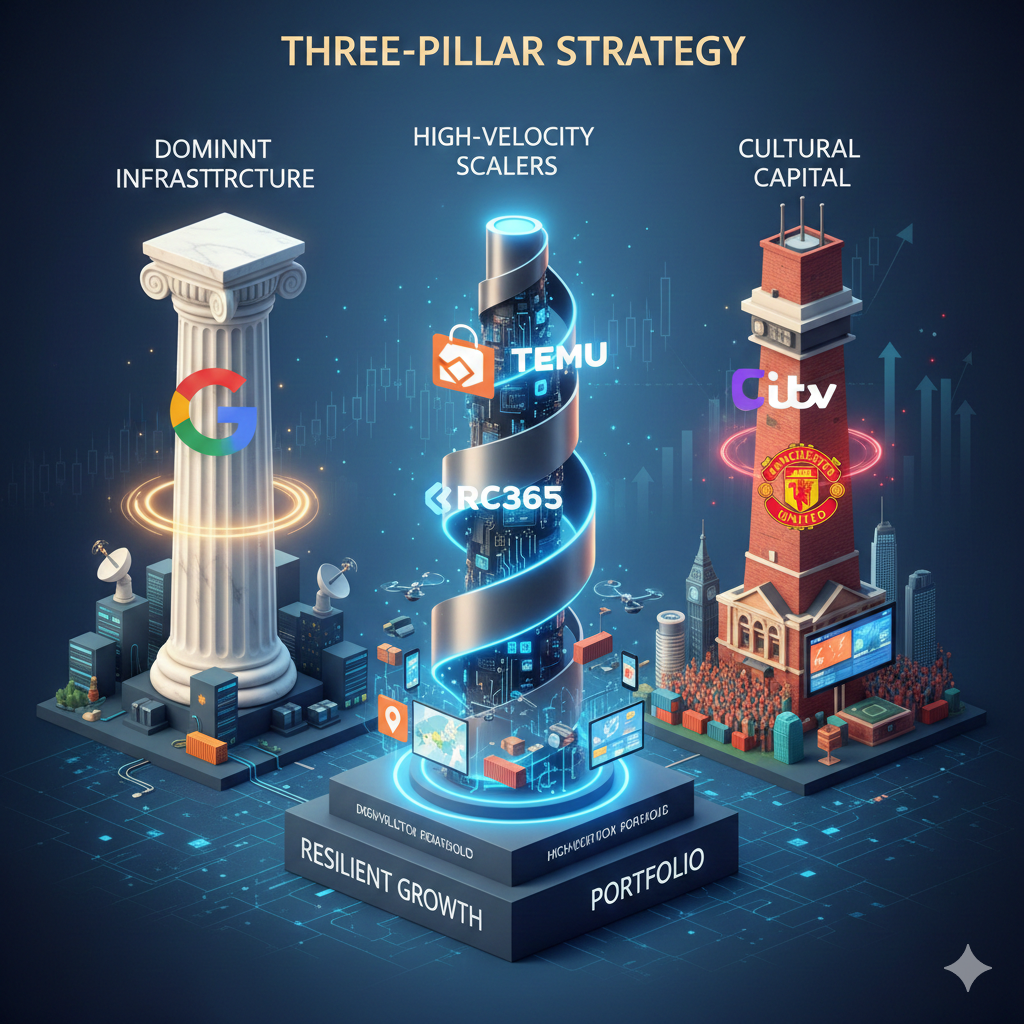
The "Resilient Growth" Portfolio: A Three-Pillar Strategy
Strategic Analysis by Independent Staff Consultant Date: December 24, 2025
In a volatile market, building a diversified investment portfolio requires more than just picking stocks; it demands a clear strategy. This article outlines a "Three-Pillar" approach, using a unique portfolio of Google (Alphabet), Temu (PDD Holdings), RC365, Manchester United, and ITV to illustrate how investors can balance stability, aggressive growth, and opportunistic turnarounds.
Pillar 1: The Dominant Infrastructure – Google (Alphabet)
This pillar represents the bedrock of your portfolio, comprising companies with unassailable market positions and robust cash flow. These are the "utilities" of the digital age, providing essential services that fuel the global economy.Business Example: Google (Alphabet)Google exemplifies this pillar. As the dominant force in search, advertising, and cloud computing (Google Cloud), it commands a vast economic moat. Its massive cash reserves and integrated ecosystem (Android, YouTube, Maps) create a powerful network effect. For investors, Google provides stability and consistent, albeit mature, growth, acting as a crucial anchor against market fluctuations. It's the dependable engine that generates the capital for more aggressive ventures.
Pillar 2: The High-Velocity Scalers – Temu (PDD Holdings) & RC365
This pillar is dedicated to high-growth disruptors poised to capture significant market share through innovative business models or rapid expansion. These companies are your "attack" assets, offering the potential for substantial capital appreciation, albeit with higher risk.Business Examples: Temu (PDD Holdings) & RC365
- Temu (PDD Holdings) is a prime example of a high-velocity scaler. Its direct-from-manufacturer e-commerce model undercuts traditional retailers, leveraging aggressive pricing and a vast product catalog to rapidly acquire users globally. Temu's strategy focuses on "extreme affordability," tapping into a universal psychological driver for consumers.
- RC365 represents a more niche, yet equally ambitious, scaler in the fintech space. Its focus on payment gateways and IT security in the ASEAN region positions it for explosive growth if it successfully penetrates these emerging markets. These assets are characterized by rapid expansion, but also by heightened volatility, requiring diligent risk management.
Pillar 3: The Cultural Capital – Manchester United & ITV
This pillar focuses on assets with significant brand power, cultural relevance, and audience reach, often presenting opportunities for a structural turnaround or a sentiment-driven rebound. Their value is frequently tied to intangible assets and potential future catalysts.Business Examples: Manchester United & ITV
- Manchester United embodies cultural capital. Despite recent on-pitch performance challenges and legacy debt, the club remains one of the world's most recognizable and valuable sports brands. Its appeal is rooted in emotional connection and a global fanbase. A potential new stadium, coupled with renewed sporting success, could unlock immense commercial value, transforming it from a "work-in-progress" into a trophy asset.
- ITV, a cornerstone of UK broadcasting, navigates the shift from linear TV to digital streaming (ITVX). While traditional advertising faces headwinds, ITV's extensive content library and growing streaming platform offer a clear path to reinvention. Both Manchester United and ITV represent "optionality" in a portfolio—investments where a successful strategic pivot or a surge in public sentiment could lead to significant re-rating.
Conclusion: A Balanced Approach
The "Resilient Growth" Three-Pillar Strategy aims to create a balanced yet dynamic portfolio. By anchoring with the stability of a dominant infrastructure player like Google, injecting growth potential with high-velocity disruptors like Temu and RC365, and adding the speculative upside of cultural powerhouses like Manchester United and ITV, investors can navigate the complexities of modern markets with a clear, disciplined approach. This framework allows for a calculated allocation of capital, designed to thrive across various market conditions.